







Introduction To The Production Process Of Formwork Panels
May 15, 2026
Leave a message
Formwork panels play a crucial role in the quality control of construction projects. The smoothness and flatness of the formwork surface directly affect the flatness of the concrete surface. Therefore, formwork production requires strict process control, improving production technology in raw material preparation, gluing, hot pressing, and trimming. The specific production process is as follows:
1. Raw Material Cutting: Raw materials are obtained by layering logs. Logs are horizontally cut and rotary-cut to a certain layer thickness. The wood layers are then cut to the same proportions according to the size of the formwork. Impurities on the surface of the wood layers are removed, as these can affect the adhesion of the glue later.
2. Drying and Drying Treatment: The wood layers after cutting and rotary cutting contain a relatively high moisture content. Therefore, for large-scale production, we use a wood drying machine for drying. The dried wood layers are relatively brittle, so they should be left to dry naturally for 2-3 days to ensure their toughness. In small-scale production, sun drying can be used.
3. Glue Application and Laying Process: A single finished construction formwork panel consists of multiple layers of wood panels bonded together using an adhesive application method. A specialized glue roller is used to apply glue evenly to both sides of the wood panels through a glue applicator. The glued wood panels are then placed flat on the formwork surface, and 6-10 layers are applied evenly (as needed).
4. Hot Pressing: After the glued and laid formwork layers are laid, they are flattened using a hot pressing process. Traditional heating methods use boiler water for heat transfer; modern equipment uses electric heating. Flattening increases the density of the formwork, resulting in a more regular shape and improved quality. The pre-pressing followed by hot pressing process minimizes the chance of misalignment, and the application of appropriate pressure and temperature during hot pressing ensures that each piece of Chinese construction formwork has good bonding strength and hardness.
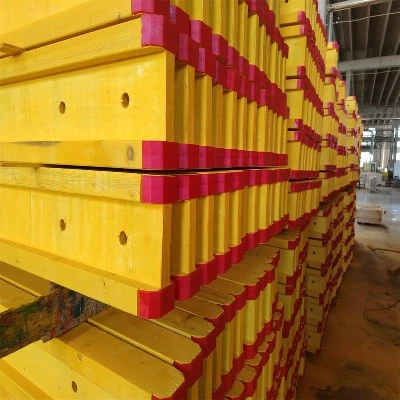
5. Painting, trimming, and packaging: After hot pressing, some inner layers of the formwork may experience misalignment and irregular edges. Excess material is trimmed with a carving knife, and then coated with anti-corrosion paint. This paint is crucial for ensuring the lifespan and storage time of the formwork. The formwork is lightweight, has high load-bearing capacity, is easy to use and bottle-packaged, has a smooth surface, and is corrosion-resistant.
Send Inquiry